

Ramadan duas, with their sources
The dua for breaking the fast, the dua for Laylat al-Qadr, and three more said in Ramadan. Each has the Arabic, a transliteration, the meaning and the hadith it comes from, linked to sunnah.com so you can check the wording and the grading yourself.
- Before FajrSehri, and the intention to fast in the heart. No set wording is reported.
- During the fast“Inni sa'im” if someone provokes you.
- MaghribBreak the fast, then “Dhahaba az-zama'u…”.
- Odd nights of the last ten“Allahumma innaka 'afuwwun…” for Laylat al-Qadr.
Dua for breaking the fast (iftar)
Said after breaking the fast at Maghrib.
ذَهَبَ الظَّمَأُ وَابْتَلَّتِ الْعُرُوقُ وَثَبَتَ الْأَجْرُ إِنْ شَاءَ اللَّهُDhahaba az-zama'u wabtallatil-'uruqu wa thabatal-ajru in sha' Allah.
“The thirst has gone, the veins are moistened, and the reward is confirmed, if Allah wills.”
Source: Sunan Abu Dawud 2357. Graded hasan.
Dua for Laylat al-Qadr
Taught by the Prophet ﷺ to Aisha for the Night of Decree, in the last ten nights.
اللَّهُمَّ إِنَّكَ عَفُوٌّ تُحِبُّ الْعَفْوَ فَاعْفُ عَنِّيAllahumma innaka 'afuwwun tuhibbul-'afwa fa'fu 'anni.
“O Allah, You are the One who pardons, You love to pardon, so pardon me.”
Source: Jami' at-Tirmidhi 3513, Sunan Ibn Majah 3850.
Dua when breaking the fast at someone's home
Said for the host after eating iftar with them.
أَفْطَرَ عِنْدَكُمُ الصَّائِمُونَ، وَأَكَلَ طَعَامَكُمُ الْأَبْرَارُ، وَصَلَّتْ عَلَيْكُمُ الْمَلَائِكَةُAftara 'indakumus-sa'imun, wa akala ta'amakumul-abrar, wa sallat 'alaykumul-mala'ikah.
“May those who fast break their fast with you, may the righteous eat your food, and may the angels send blessings upon you.”
Source: Sunan Abu Dawud 3854.
If someone insults or provokes you while fasting
The Prophet ﷺ told the fasting person to say this instead of answering back.
إِنِّي صَائِمٌInni sa'im.
“I am fasting.”
Source: Sahih al-Bukhari 1894, Sahih Muslim 1151.
“Allahumma laka sumtu” (widely said, weak chain)
Very common at iftar. The report is mursal (a link in the chain is missing), so scholars grade it weak; the dua above from Abu Dawud 2357 is the stronger one.
اللَّهُمَّ لَكَ صُمْتُ وَعَلَى رِزْقِكَ أَفْطَرْتُAllahumma laka sumtu wa 'ala rizqika aftartu.
“O Allah, for You I fasted, and with Your provision I break my fast.”
Source: Sunan Abu Dawud 2358. Graded da'if (mursal).
Verses about fasting
- Fasting is prescribed “as it was prescribed for those before you, so that you may attain taqwa” (Quran 2:183).
- “The month of Ramadan in which the Quran was revealed…” (Quran 2:185).
- “When My servants ask you about Me, I am near; I answer the call of the caller when he calls on Me” (Quran 2:186), placed among the verses on fasting.
- Laylat al-Qadr “is better than a thousand months” (Surah al-Qadr, 97).
Translations are paraphrased for reading; follow the links for the full text and gradings. This page is not a religious ruling.
Duas on your phone, offline
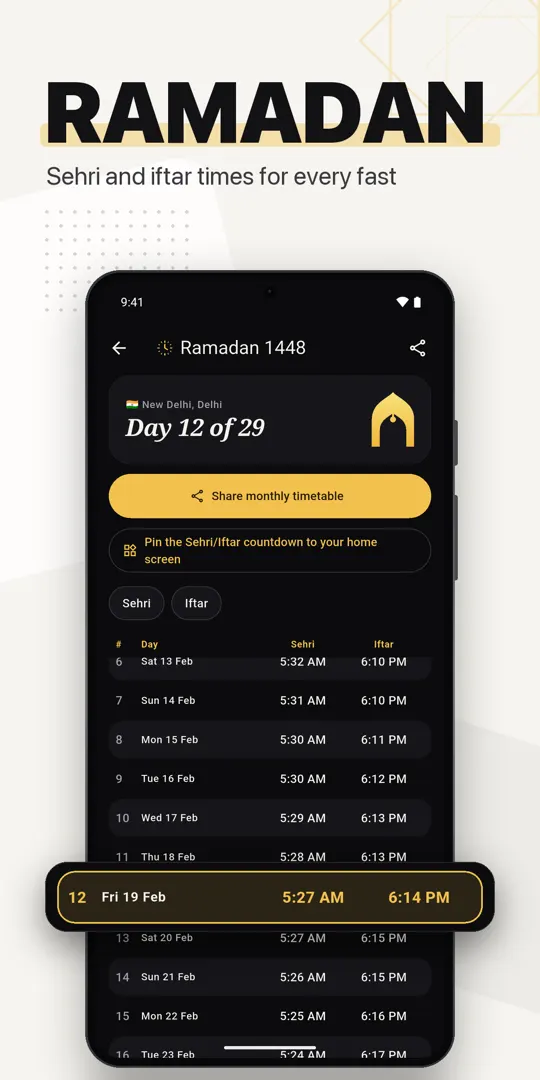
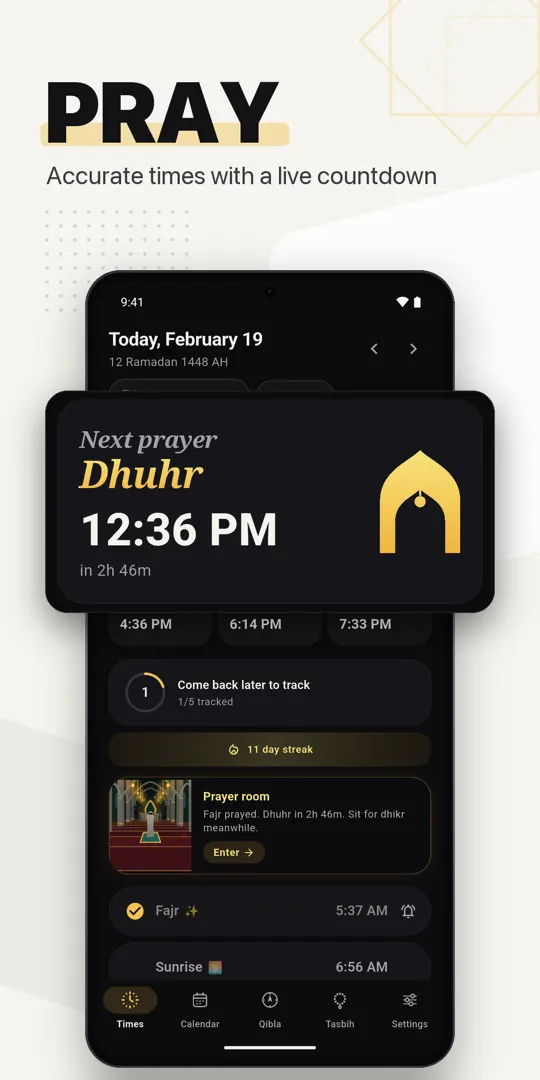
The Namaz Time app has a dua section with the first four duas on this page (not the weak one) in Arabic with transliteration, meaning and source, next to your city’s Sehri and Iftar times. It works without internet.
Questions
- What is the dua for breaking the fast?
- Dhahaba az-zama'u wabtallatil-'uruqu wa thabatal-ajru in sha' Allah: "The thirst has gone, the veins are moistened, and the reward is confirmed, if Allah wills" (Sunan Abu Dawud 2357). It is said after breaking the fast. Say Bismillah before you start eating.
- Is there a dua for the intention (niyyah) of fasting?
- The intention is in the heart and is made before Fajr for each obligatory fast. No wording for it is reported from the Prophet ﷺ; the phrases printed on some timetables are later formulations.
- What dua should I make on Laylat al-Qadr?
- Allahumma innaka 'afuwwun tuhibbul-'afwa fa'fu 'anni: "O Allah, You are the One who pardons, You love to pardon, so pardon me" (Jami' at-Tirmidhi 3513). In 2027 the odd nights of the last ten begin at sunset on 27 Feb, 1, 3, 5 and 7 March if Ramadan starts on 8 February.
- Is the dua of a fasting person accepted?
- A hadith in Jami' at-Tirmidhi (3598) names the fasting person until he breaks his fast among three whose supplication is not rejected. Many people make their own duas in the minutes before iftar.